An account that has not been mutual
Moreton Bay supports a commercial and recreational fishery worth more than a hundred million dollars a year. It carries a Marine Park visitor economy. It holds a Ramsar designation that confers international standing. Its coastline has not yet collapsed under its own development pressure, though it has been tested.
Most of the work that holds this together is done by organisms whose contribution does not appear on any balance sheet. Microbes, biofilms, seagrass, mangroves, polychaete worms, the small crabs that turn the substrate, the larger fish that eat them — and the shorebirds, who eat the worms and crabs and biofilm and in doing so keep the whole intertidal system running.
The conventional conservation argument asks that we protect shorebirds because they are vulnerable, beautiful, magnificent flyers. That argument has its place. But it is not the whole truth, and it carries an implicit asymmetry: the human as moral agent, the bird as recipient of our overdue care.
The reciprocal truth
The birds do not sit at the buffet for free. They have been paying their share since long before there were humans here to count. They eat the crabs that would otherwise destabilise the bay. They maintain the biofilm that holds the sediment that supports the seagrass that nurses the prawn fishery that feeds us. They have been doing structural work for millennia. We have been, on balance, asset strippers — extracting fish, oysters, dredge spoil, foreshore real estate — while contributing very little back to the system that produced any of it.
The trophic ledger is brutally one-sided. The birds are the unpaid maintenance crew.
What follows is what they actually do. Six tangible services. None of this is sentimental. All of it is measurable, and increasingly, measured.
Six services
1Sediment stability — protecting the mudflat itself
Shorebirds eat polychaete worms, small crabs and molluscs that would otherwise overgraze the microphytobenthic biofilm — the thin algal-bacterial mat that binds the surface of intertidal mud and produces oxygen. Without that biofilm, the mudflat itself becomes structurally unstable.
An exclusion experiment on the Colne Estuary in the UK fenced shorebirds off plots of mudflat for forty-five days. The result was measurable: sediment in the bird-excluded plots became significantly more erodible. The flat literally began to come apart faster.
Evidence: Booty et al. 2020, Frontiers in Marine Science — open access, peer reviewed.
2Nutrient cycling — moving nitrogen and phosphorus where they need to go
The same exclusion experiment found that when shorebirds were absent, nitrate efflux from sediment dropped, phosphate uptake patterns changed, and the entire nitrogen-phosphorus balance of the intertidal zone shifted. Birds also concentrate nutrients at high-tide roosts through guano, enhancing local productivity at predictable points along the shore.
They are slow, low-volume, but persistent biogeochemical engineers. Take them out and the chemistry of the bay changes in ways the bay's other inhabitants notice.
3Trophic cascades — keeping the food web intact
Top-down predation by shorebirds prevents crab populations from exploding and overgrazing native saltmarsh vegetation. Where shorebirds are removed — experimentally or through sustained population decline — saltmarsh die-off has been documented in Yellow Sea sites where the loss of shorebirds preceded the loss of vegetation by years.
The cascade is not theoretical. It is what happens when one rung of the structure goes missing.
4Mobile links — flyway-scale connection
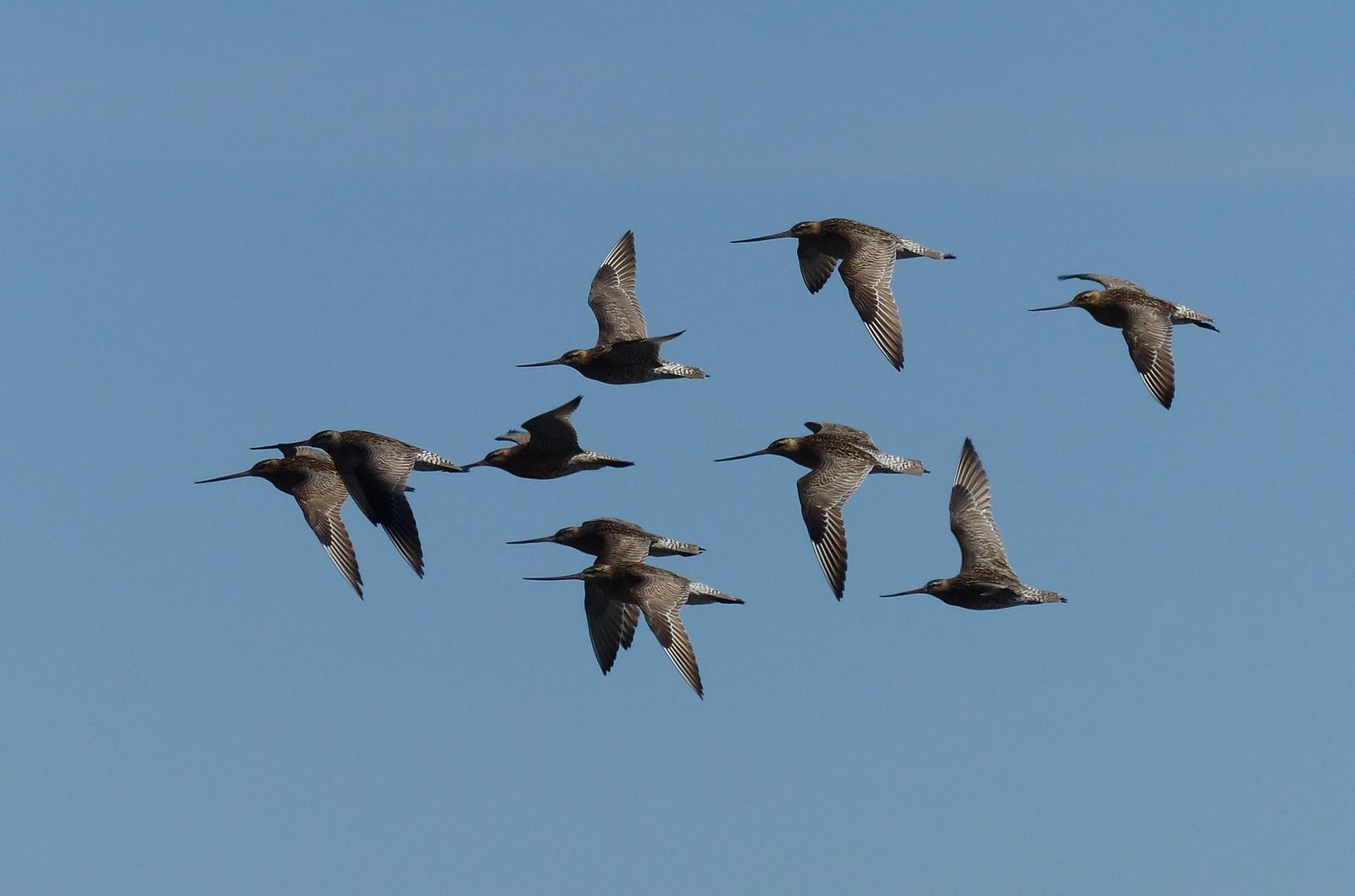
A Bar-tailed Godwit physically connects the Yukon-Kuskokwim Delta in Alaska, the Yellow Sea staging hubs, and Moreton Bay every year of its life. Through that connection it transports nutrients, parasites and pathogens (with epidemiological consequence), genetic material, and information about climate signals across ocean basins.
Without migratory shorebirds, these distant ecosystems are no longer biologically coupled. The flyway is held together by the birds themselves.
5Indicator function — the canary that reads the whole system
Shorebird abundance, diversity, body condition and timing are leading indicators of intertidal ecosystem health. They integrate signals about water quality, prey availability, disturbance regime and habitat continuity that no single instrument captures.
A thirty-year decline in Bar-tailed Godwit numbers at Moreton Bay is not just a bird-conservation problem. It is the bay reporting on itself. The Steward role is, in part, to be the human who reads that signal.
6Cultural and economic services — what shorebirds do for people
Birdwatching tourism, environmental education, citizen science, mental health benefits from nature exposure, Indigenous cultural connections — all are tangible services that shorebird presence delivers. Single-region examples generate tens of millions of dollars annually (Delaware Bay birdwatching: roughly US$34 million per year). Yellow Sea ecosystem services have been valued at around US$200 billion annually.
For Moreton Bay specifically, shorebird presence underwrites Marine Park visitation, contributes to Ramsar designation, and co-locates with the seagrass and intertidal flats that also serve as commercial fishery nursery and as blue carbon stock.
Beauty and reckoning
Some people will reach this work through love — through the photograph of a magnificent flyer, through a Gazza story, through a child’s wonder at a flock turning over the bay. That door is real and it works for the kind of person it works for.
Others will reach it through reckoning — through the recognition that we have been beneficiaries of work we have not been paying for, and that the workers are quietly going under from the strain. That door is also real, and it works for a different kind of person, often one who finds the sentimental conservation argument easy to dismiss.
Not charity. Payment toward an account long overdue.
The Steward Program is built on the recognition that the birds have done their part. The question it puts back to anyone reading this is what we, as humans who have benefited from their work for generations, choose to do in return.
Not as kindness extended toward vulnerable creatures. As payment toward an account that has been one-sided for far too long.
We just need to Act.