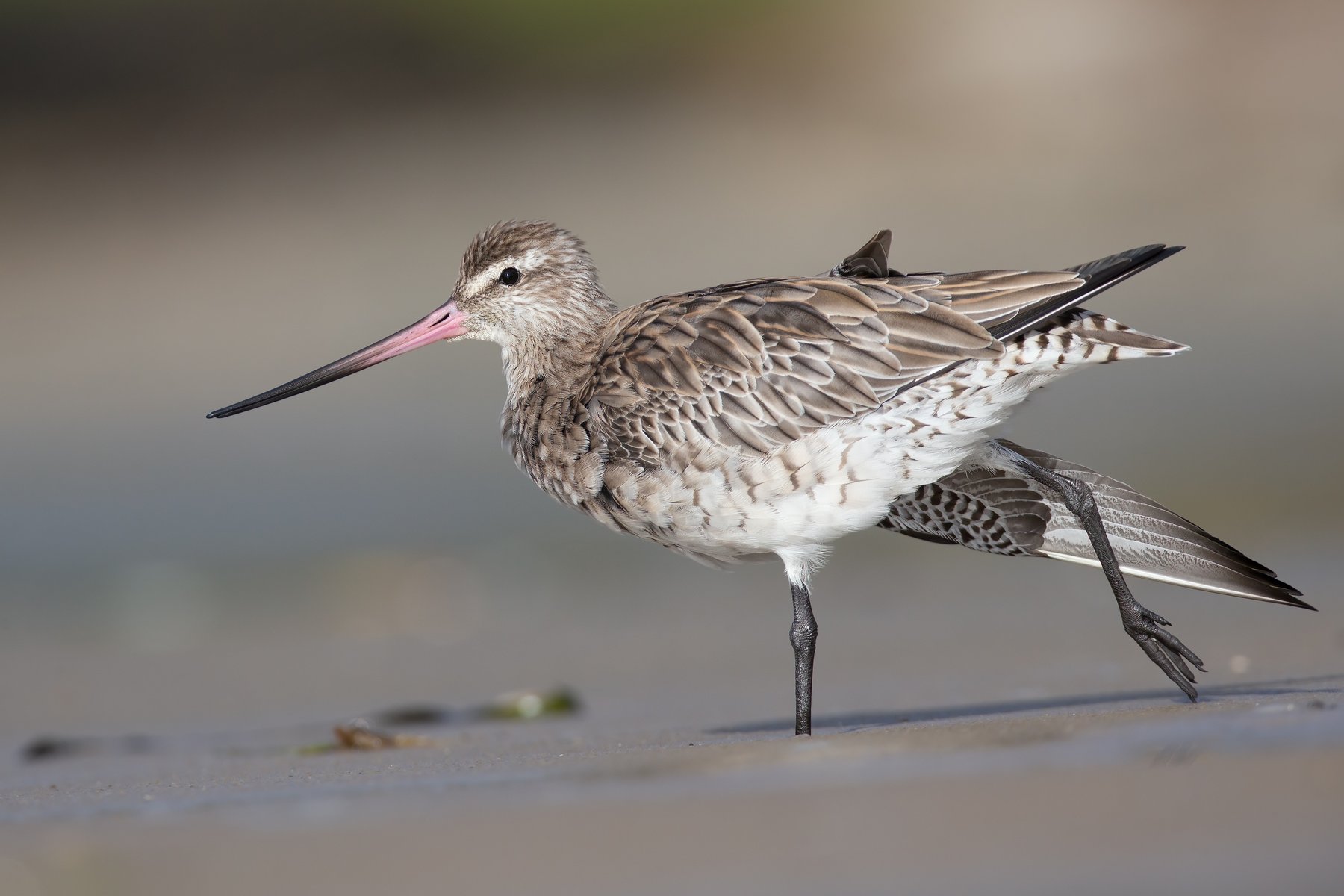
I saw the nets too late.
One moment I was probing for lugworms in the pre-dawn darkness, the next I was tangled in invisible mesh, hanging upside down like a feathered piñata while graduate students scrambled through the mud.
"Got one! Adult male, excellent body condition!"
"That's not just 'one,'" Dr. Chen said, approaching with her equipment case. "That's LLB. Lower Left Blue." She smiled. "Hello, Gazza. Time for you to contribute to science."
The transmitter weighed 5 grams, just over 1% of my body weight, the ethical maximum. But it wasn't just a transmitter. This was ARTEMIS v2.3: Adaptive Real-Time Migration Information System.
"Revolutionary," Dr. Chen explained while I glared. "AI-assisted biological monitoring during flight."
The moment they activated it, a tinny voice chirped:
"Hello! I'm ARTEMIS! Together we'll optimize your flight efficiency by 34%!"
"I've been flying this route for six years without help."
"But now we can quantify everything! Your metabolic rate, organ shrinkage, muscle catabolism, all in real-time!"
The attachment was surgical-grade epoxy. Permanent until moult. I was stuck with an AI narrator for the next 11,000 kilometres.
Launch Night · September 18th, 18:00The flock gathered on the upper beach, feeling the north wind building. We weren't breeding birds anymore, those lean, aggressive defenders of tundra territories. We were migration machines, transformed by three weeks on the mudflats.
"Pre-flight status! Subject weight: 618 grams! Breeding weight was only 340 grams! Fat comprises 53% of current body mass!"
"Slightly suboptimal. Should be 55%."
"Adjusting flight duration calculations! Estimated arrival: 216 hours!"
The flock launched together, forty-three godwits rising into the Arctic dusk. ARTEMIS immediately began her commentary:
"Wingbeat frequency: 7.2 Hz! Heart rate: 674 BPM! Angle of climb: 32 degrees! Incredible data!"
Hour 24Settling Into Rhythm
"Update! We've covered 1,987 kilometres! Altitude: 3,200 metres! Your digestive system has shrunk another 5% since launch!"
"Normal."
"Normal?! You're dissolving organs while flying! This would kill any mammal!"
"Good thing I'm not a mammal."
"Your metabolic rate is 10.2 times baseline! You're producing 127 kilojoules of heat per hour!"
"Need it. So I don't freeze."
"Actually, 67% is waste heat! Only 33% maintains core temperature! Thermodynamically inefficient!"
"Inefficient?" I snapped. "I'm flying non-stop to Australia powered by my own dissolved organs. You're powered by a tiny solar cell and you're not even carrying yourself. Which one of us is inefficient?"
"…Point taken. Logging defensive response."
Hour 48The Feeling
I felt it before I saw anything. A wrongness in the air, deep vibrations below what humans can hear. Infrasound. The pressure signature of something massive building to the south-west.
Storm. Big one. Maybe 800 kilometres out.
My gut said climb. Get above it. Ride the outflow rather than fight the inflow. I've done it before, not at this scale, but the principle's the same. Use the system's energy instead of wasting yours against it.
"Atmospheric anomaly detected! Analysing pressure differentials… Tropical Cyclone Maysak identified, approximately 780km south-southwest! Fascinating! Your altered wingbeat pattern preceded my satellite data by 340 seconds!"
"I know there's a storm."
"Of course! Your species detects infrasound below 0.1 Hz, weather systems generate signatures at 0.05 Hz! You're essentially a biological barometer! I'm merely confirming what you already sensed!"
Merely confirming. Right.
Hour 72The Decision
Day three. The clouds were visible now, a wall of grey and black stretching across the horizon. The infrasound had become a physical pressure, a wrongness that made every feather itch.
I knew what I needed to do. Climb high, catch the outflow winds at the top of the system, let it sling me around and past. It would be brutal, thin air, freezing cold, oxygen so scarce my muscles would scream. But it was the move.
"Current survival probability if maintaining present altitude and heading: 12%! However, if you climb to 4,800 metres, you'll access the anticyclonic outflow! The system's rotation will actually assist your trajectory!"
I was already climbing.
"Excellent decision! This aligns with my recommendation! Shall I log this as 'AI-assisted navigation'?"
"Log it as 'godwit does what godwits do.'"
"Log it as 'godwit does what godwits do.'"
— Gazza, LLB-234684, Hour 72, altitude 4,847 m
"Interesting! Your chosen altitude of 4,847 metres is within 0.8% of my calculated optimum! The convergence between instinctive and computational navigation is remarkable!"
Convergence. That's one word for it. Another word is: I've been flying this route since before you were a line of code, you glorified pedometer.
But I didn't say that. Because somewhere in the howling wind at the edge of the stratosphere, I had an uncomfortable thought: the bloody thing wasn't wrong. It was just… putting numbers on what I already knew.
I didn't like the thought. I filed it away for later. Preferably never.
Subject initiated climb 340 seconds before ARTEMIS recommendation. Instinctive and computational optima converged within 0.8%. Logged as: "Godwit does what godwits do."
Halfway There
My son B6 pulled alongside. First migration. He was struggling.
"Dad, my wings hurt."
"Everyone's wings hurt."
"The voice in your feathers keeps saying we're dying."
"Correction! I said cellular damage is accumulating at 2.3% per hour! This is within normal parameters for godwit migration!"
"See? Normal."
"It also said you're metabolising your own intestines."
"Autocannibalism is a feature, not a bug! The digestive system isn't needed during flight! It's converted to fuel! Remarkable efficiency!"
B6 stared at me with profound horror.
"Your grandmother flew this route fifteen times. You'll be fine."
Hour 200The Final Push
"Fat reserves at 8%! Muscle catabolism initiated! Flight muscle mass reduced by 23%!"
"I know."
"Heart rate declining! Efficiency dropping! Recommend reducing altitude to conserve—"
"I can see the coast."
"…Recalculating. Australian continental shelf detected. Estimated arrival: 11 hours."
Eleven hours. After eight days, eleven hours felt like nothing.
It also felt like forever.
Hour 211Landfall
Australia appeared as a brown smear on the horizon. Nine days without food, water, or rest. I'd burned through 280 grams of fat and a significant portion of my internal organs.
"ARRIVAL IMMINENT! Final statistics compiling! Distance covered: 11,247 kilometres! Average speed: 53.3 km/h! Weight lost: 294 grams! You've consumed 47% of your departure mass in fat and organ tissue!"
"Is there an off switch?"
"Data transmission will continue throughout your non-breeding season! Together we'll document roosting behaviour, feeding efficiency, moult timing—"
I hit the mudflat face-first. Didn't care. Solid ground. Food. Rest.
B6 landed beside me, somehow still alive.
"We made it."
"Course we did."
EpilogueThe Reckoning
B6 looked at me with something like respect.
"Dad, the chatty backpack kept saying things right before you did them. Like it knew what you were going to do."
"It didn't know anything. It just calculated what any sensible godwit would do, then claimed credit."
"So your instincts and its computers agreed?"
"My instincts are fifty million years of evolution. Its computers are, what, five years old? It's not agreement. It's confirmation that godwits were right all along."
"Actually, the convergence between instinctive and computational optima occurred on 94.3% of significant navigation decisions! This suggests your species has evolved near-perfect—"
"Shut up."
B6 smirked. "You're annoyed because the robot proved you were right."
"I'm annoyed because I didn't need a robot to prove I was right. I already knew I was right. That's what instincts are."
"Excuses," he said, and waddled off to feed.
The little bastard had a point, though. Somewhere over the Pacific, fighting through a cyclone at the edge of space, I'd had an uncomfortable thought: maybe the value of ARTEMIS wasn't in telling me what to do. Maybe it was in showing the humans that what we do isn't magic or luck, it's precision. Biological engineering so sophisticated their best algorithms could only match it, never beat it.
Fifty million years of R&D, and their computers finally caught up.
Not that I'd ever admit that to the thing on my back.
Neither, it seems, is the ability to save ourselves from extinction. For that, we need humans to read our data and act. And so far, they're better at collecting it than using it.
All scientific facts are accurate. Only the attitude is fictional.