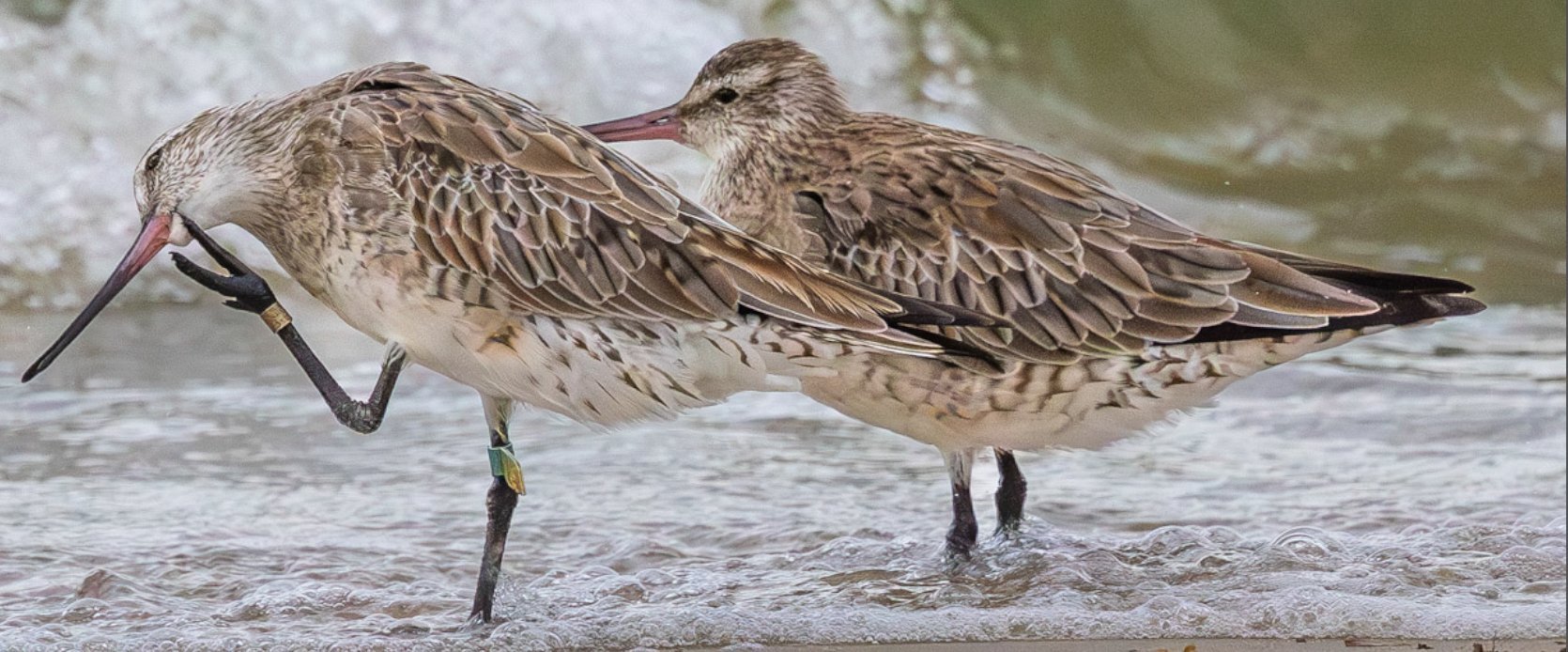
An old godwit who pays attention.
Gazza is a teacher’s aide. The course sits in the background readings and your time at the bay — and you can work through it two ways. With Gazza, who walks you through and asks the questions. Or self-directed, using the bibliography and study guide at your own pace. Either pathway lands you in the same place.
In the public chat he’s brief and observant. Once enrolled, the aide is dialled up: deeper, slower, more questioning. You’re serious now, and he treats you accordingly.
Getting the most
from Gazza.
Gazza is a conversation, not a search box. Seven moves to use him well.
Start with what you actually want to know.
Don't write a polite question. Write the one that's been bothering you, the flush at high tide that felt wrong, the bird that didn't match the field guide, the number you couldn't reconcile with what you saw.
Push back when it doesn't match what you've seen.
Gazza knows the science. You know the bay you watched yesterday morning. If he says one thing and your morning showed you another, say so. Gazza will tell you when the literature has nothing to say about what you observed.
Ask for examples from your bay.
Not "explain Battley 2000", "explain Battley 2000 in terms of what I'd see at Toorbul next week." Gazza can't always anchor a paper to your specific site without you giving him the anchor. Tell him where you're going and what tide.
Connect papers.
"How does this relate to FID?" "Where does Murray 2014 connect to what I see at the bay?" Cross-paper questions are where the training shifts from individual papers to field-applicable understanding.
The dumb question is often the conversation-opener.
"Why does it matter where the godwit goes after the bay?" sounds basic. It's the question every public visitor asks. Practising the answer with Gazza means you can answer it at the waterline without scrambling for a script.
When Gazza says he doesn't know, believe him.
He can speculate, and he'll flag it when he does. He doesn't pretend. The answers you do get are reliable because of that boundary.
End with the next move.
Gazza will offer you one, a thing to watch for, a paper to read, a public conversation to practise. Take it. Each conversation should leave you with one specific next move. Come back next week with what you found.
Gazza answers in the same rhythm: substance first, then one specific next move.
Fair use
and rhythm.
How Gazza works, and why the limits are there.
Gazza is the AI teacher’s aide for fifteen Stewards across one six-month cohort. He is here for thinking, not for company. He is good at: interpreting the science, supporting your fieldwork, pushing back when something does not add up, helping with what comes next. He is not for: being a daily companion, filling time, doing your reading for you. Those go elsewhere.
The most useful conversations are short, focused, and tied to something you are about to do at the bay. Bring the question. Get the answer and the next move. Act on it. The training compounds when you act between conversations.
Three soft limits keep the rhythm intact:
When a limit is reached Gazza will close the session politely and tell you when he will be back. The limit working is the program working, there is nothing to apologise for. The rhythm exists to protect you from talking about shorebirds when you should be standing on a mudflat with a notebook.
If a genuine reason takes you past the budget, unusual circumstances, a piece of fieldwork that needs prolonged guidance, write to me at [email protected]. The cap is soft because the program is small and Stewards bring different lives. We work it out. But before you write, ask yourself whether more time with Gazza would help your fieldwork, or whether you have drifted into using him as something he isn't.
The same bird who wrote those stories is waiting to interview you.
Talk to GazzaTen minutes.
Before the tide calls.
"The bird feeding quietly on the mudflat in front of you in March may have nine days of non-stop flight ahead of it. A dog off-leash at that point in the season is not a small thing. That is what the science says."Gazza · Bar-tailed Godwit · Teacher’s Aide · Shorebird Steward Program
Choose your Gazza
Select one to continue
Shorebird Steward Certification
Two days at Jacobs Well EEC, supervised field practice, certified on completion. ShorelineWatch stays with you; FlagWatch joins the toolkit.
Watcher
Eight questions from Gazza. Pass six. Access to ShorelineWatch. Free. No cohort required. Start now.