A cyclic training program.
Training. Site visit. Review with Gazza. Updated lesson plan. Next visit. The cycle is the curriculum.
Your tutor is Gazza. He is online 24/7.
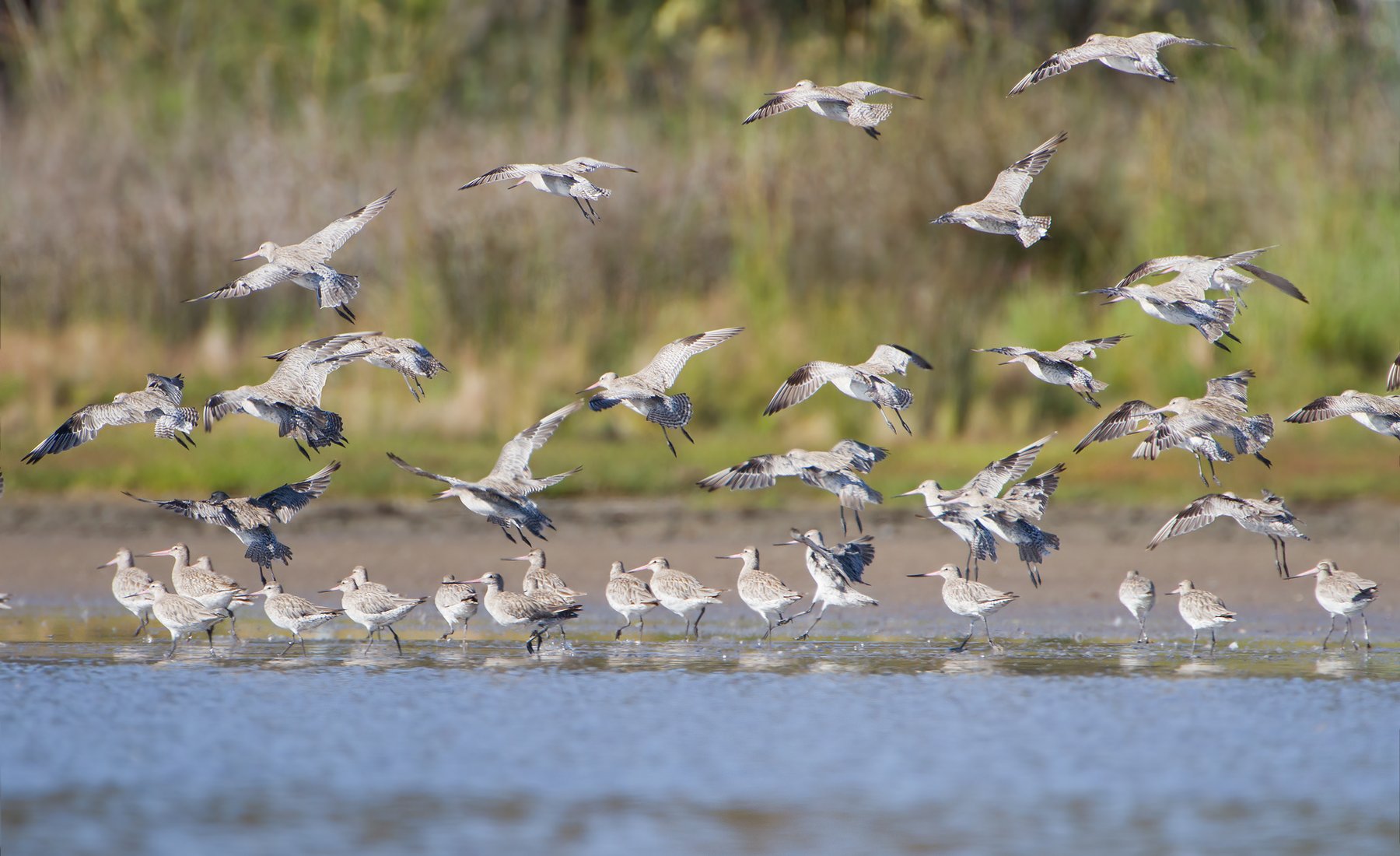
Gazza is a male Bar-tailed Godwit who has flown the East Asian–Australasian Flyway eight times. He is the AI Teacher's Aide for this program. He sits on the other end of every conversation in the cycle.
Before he teaches you, he interviews you. Before every return conversation, he reads your ShorelineWatch records. After every session, he revises your lesson plan.
Two complementary modes.
Stewards work the course material in two modes, and most use both as the work asks for them. Neither replaces the other. You drift between them as you go.
When you have a question, when you’ve come back from the bay, when you want your plan updated, when you’ve read something and want to talk it through. Gazza is online 24/7, expert mode, for six months from enrolment. He reads your ShorelineWatch records and your field notes before he answers. He sets you readings; he is not a textbook reciting them.
The Study Guide sequences the readings around the Ng (2026) intervention topics, interleaved with FSB’s own material. The Resources orbit gives you the eight topic constellations. The annotated bibliography is the deep scholarly reference. You don’t need Gazza’s permission to wander. Some Stewards do most of their work this way and only come to Gazza when something specific catches.
The training cycle.
Eight stages between one Gazza interview and the next: training, site visit, review, new goals, updated lesson plan, next visit. The cycle repeats through every stage of the program.
First time through. Gazza builds your lesson plan from scratch.
Reading first. Interpreting where it fits.
Stewards do not all begin in the same place. Gazza interviews you, identifies where to start, and writes the lesson plan from there. The practice itself begins with reading, and for some Stewards extends to interpreting at the waterline.
Learning the language of the site. Tidal state, species, behaviour, disturbance signals, seasonal rhythm. You show up at the right tide, you record what you see, you submit even when there's nothing. This is the foundation, and for some Stewards it is the whole of the work.
Reading turns into reading-aloud. You explain what's happening to a stranger on the boardwalk. You translate what you see into language anyone can hear. Some Stewards know from the start this is for them. Some find it grows on them once the birds are familiar and a conversation opens up. Some never want it, and that’s fine. Interpreting is a personal choice, not a stage in a ladder.
What you'll be able to do.
Ecological literacy in relation to shorebirds. Concretely:
- Read a flock without disturbing it. What species are there, how many, what they're doing, what they're about to do.
- Recognise disturbance. Distinguish a natural event from a human-caused one, and record what you saw.
- Contribute observations that count. Records that build a continuous, peer-readable picture of the City of Moreton Bay across the seasons.
- Talk about what you see to a stranger on the boardwalk, a child, a fellow visitor. With confidence, because you've been there.
- Bring others into the practice. Once you've come round the cycle a few times, you have something to teach.
A$95. Once. Six months.
A single enrolment fee covers everything below. There is no subscription. There are no upgrades. The fee runs for six months from your enrolment date.
- Two-day field trip. Jacobs Well EEC. Research vessel on the bay. Supervised field practice at the roost sites with the delivery partner. No test. Timed close to the September migratory return. Participants make a catering contribution set by Jacobs Well EEC.
- Gazza, the teacher's aide you've already met. Enrolment opens expert mode and the full course library. Available 24 hours a day, 7 days a week. He has been reading your ShorelineWatch records since your first one. Updates your lesson plan after every return conversation.
- Your personal lesson plan. A named page in the Steward portal, written in Gazza's voice, revised at every cycle. Each cycle's plan also arrives by email after your return conversation.
- ShorelineWatch and FlagWatch. Both field instruments installed and trained. Your records join the longitudinal City of Moreton Bay dataset.
- Background Reading library. Peer-reviewed flyway science, curated and contextualised.
- 3D printed Shorebird Steward badge. Bar-tailed Godwit silhouette, issued on completing the field trip.
- Shorebird Steward certification on completing the field trip.
- Priority placement at delivery partner sites for ongoing field practice.
Registration now, enrolment when the cohort opens. The form captures your name and email. When the first cohort formally opens — late June / July 2026 — you'll receive a link to complete enrolment. The A$95 fee covers six months of access from that date.
The birds are at the waterline.
The program starts with a conversation.
Register your interest for the first cohort. Late June / July 2026, ahead of the September migratory return.
Not ready for the course? Start as a Field Observer — no course required, your records count from the first visit.
"We protect what we love. We love our kin. The birds are still waiting, to be recognised, as kin."